 Shallow marine
ostracod ecology
Shallow marine
ostracod ecology
Leader: Margaret Morley (deceased)
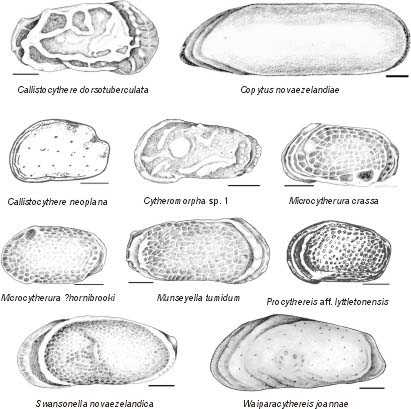
Ostracoda are microscopic crustacea (sometimes called water-fleas) that
mostly live in water and are characterised by the possession of calcified, bivalved shells that when they die are commonly buried by
sediment and preserved as fossils. The goal of this programme, involving
Margaret Morley and Bruce Hayward, is to document the biodiversity and
ecological distribution of the shallow marine and estuarine Ostracoda of New
Zealand, particularly the northern
Study areas:
a. Intertidal and shallow subtidal zonation, Whangapoua
Harbour, Coromandel – published, 2006.
b. Impact of increased freshwater runoff, Waitemata Harbour – published, 2006.
c. Ecological distribution, Waitemata Harbour – published, 2007.
d. Impact of introduced Asian date mussels and chord grass, Raglan Harbour,
Firth of Thames, Tamaki Estuary, Mahurangi Harbour, Kaipara Harbour – published,
2008.
e. Microfossil record of the Holocene breaching of
f. Ostracod distribution in Big
Lagoon, Marlborough and use in paleogeographic history – published, 2010.
g. Elevational zonation of ostracods living among coralline-turf on
h. Biodiversity and distribution of
modern ostracods in the
i. Biodiversity and
distribution of modern ostracods in Matai Bay, Northland –Published, 2014.
j. Biodiversity and
distribution of modern ostracods of the Cavalli Islands, Northland – Published,
2016.
Publications
- Morley, M.S., Hayward, B.W., 2016. Ostracoda of the Cavalli Islands, Northland, New Zealand. Records of the Auckland Museum 51, 79-93.
- Morley, M.S., Hayward, B.W., 2014: Biodiversity and distribution of Ostracoda, Foraminifera and Micromollusca of Matai Bay, Northland. Records of Auckland Museum 49: 55-80.
- Morley,
M.S., Hayward, B.W., 2012: Ostracoda of the Hauraki Gulf, New Zealand. Records
of
- Morley,
M.S.,
- Hayward, B.W., Wilson, K., Morley, M.S., Cochran, U., Grenfell, H.R., Sabaa, A.T., Daymond-King, R., 2010: Microfossil record of the Holocene evolution of coastal wetlands in a tectonically-active region of New Zealand. The Holocene 20: 405-421.
- Hayward, B.W., Grenfell, H.R., Sabaa, A.T., Morley, M.S., 2008. Ecological Impact of the introduction to New Zealand of Asian Date Mussels and Cordgrass – the Foraminiferal, Ostracod and Molluscan Record. Estuaries and Coasts 31: 941-959.
- Morley, M.S., and Hayward, B.W., 2007. Intertidal and shallow-water Ostracoda of the Waitemata Harbour, New Zealand. Records of Auckland War Memorial Museum 44: 17-32.
- Morley, M.S., and Hayward, B.W., 2006. Molluscs and ostracods in a tidal transect from Whangapoua Harbour, Coromandel Peninsula. Poirieria 32: 24-33.
- Hayward, B. W., Grenfell, H. R., Sabaa, A., Morley, M. S., and Horrocks, M., 2006. Impact and timing of increased freshwater runoff into sheltered harbour environments around Auckland City, New Zealand. Estuaries and Coasts, 29: 165-182.
- Hayward, B.W., 1982. Foraminifera and ostracoda in nearshore sediments, Little Barrier Island, northen New Zealand. Tane, 28: 53-66.
- Hayward, B.W., 1981. Ostracod fauna of an intertidal pool at Kawerua, Northland. Tane, 27: 159-168.