Chatham Islands 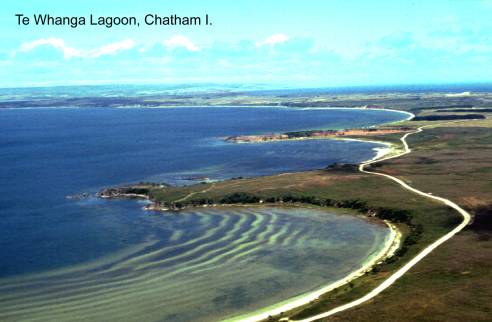
Blind Jim's Beach
to Waipapa Creek Eocene fauna. Map: CH;
Classification: B2. Significance: Some of richest Eocene faunas in New Zealand. Limestone
composed of large foraminifera of genus Asterocyclina.
Oldest larger foraminiferal locality
(Asterocyclina limestone) in New
Zealand. Rich shark tooth locality.
Cascade Gorge carbonates. Map: CH;
Classification: C2. Significance: An occurrence of unusual carbonates.
Chatham
Island
schist. Map: CH; Classification: B3. Significance: One of the best and most
easily accessible exposures of Chatham Island schist.
Chatham
Island
southern cliffs. Map: CH; Classification: C3. Significance: Spectacularly high cliffs form the imposing southern
coast of Chatham Island. Several streams form impressive waterfalls over the cliffs.
Chatham Islands
petroglyphs. Map: CH; Classification: B1.
Significance: Best preserved example of Moriori rock
carving.
Hakepa plug, Pitt Island. Map: CH;
Classification: C3. Significance: Well exposed trachyte
plug.
Henga
limestone pinnacles, Chatham Island. Map: CH; Classification: C2. Significance:
One of the best examples of karstose limestone on Chatham Island. Limestones
of this age are rare on mainland New Zealand.
Korako limburgite plug. Map: CH;
Classification: C3. Significance: Well exposed plug of Northern Volcanics forming prominent conical
hill.
Mangere
Island
breccia with hornblende xenoliths. Map: CH;
Classification: B3. Significance: Breccia containing
mantle and crustal xenoliths. Hornblende xenoliths are
of importance in relating the magmatic history of the
rocks and of the crust beneath the Chathams.
Momoe-a-toa Pliocene shellbed and basalt with
hornblende xenoliths. Map: CH; Classification: B3. Significance: Well
exposed continuous exposure of basalt and tuff, with associated richly fossiliferous beds - one of the richest Pliocene
macrofossil fauna in New Zealand. Basalt contains
mantle xenoliths and megacrysts, including hornblende
which is of importance in relating the magmatic
history of the rocks and of the crust beneath northern Chatham Island.
Motuhou Point mushroom rock, Chatham
Island. Map: CH;
Classification: B1. Significance: An unusual mushroom-shaped erosion feature,
rare throughout New Zealand.
Motutapu Point Whenuatara Tuff. Map: CH; Classification: B3. Significance:
Diverse Pliocene molluscan fauna.
Mt Dieffenbach plug.
Map: CH; Classification: B3. Significance: Prominent conical hill formed by
erosion of a volcanic plug.
North Chatham
peat swamp. Map: CH; Classification: B2. Significance: One of New Zealand's best examples
of a peat swamp.
Ohira Bay columnar jointed
basalt. Map: CH; Classification: B2. Significance: One of the best examples in New Zealand of columnar
jointed basalt forming a New Zealand version of the Giant’s
Causeway. Excellent xenoliths of olivine.
Owenga pillow lava and wave-cut platform, Chatham
Island. Map: CH;
Classification: A1. Significance: Best three dimensional example
in New Zealand of pillow lava,
and only known occurrence in the world of lava stalactites inside pillow lava
tubes. Pillow lava well displayed on spectacular wave-cut platform.
Point Weeding Eocene
fossils, Waikarupi. Map: CH; Classification:
C3. Significance: Diverse Waipawan molluscan, echinoid and brachiopod fauna.
Rangiauria Breccia islands, Pitt Strait. Map: CH;
Classification: C3. Significance: Conspicuous steep sided islands in volcanic breccia: Mangere, Little Mangere, The Castle and Sail Rock.
Rangiauria Breccia pipes, Pitt Island. Map: CH;
Classification: B3. Significance: Magnificently exposed pipes (diatremes) of volcanic breccia
(comparable with Kakanui Breccia).
Red Bluff Eocene fossils.
Map: CH; Classification: C3. Significance: Diverse Waipawan
molluscan, echinoid and brachiopod fauna in palagonitic tuff.
Rockyside
Bay
unconformity and Eocene hardground fauna. Map: CH;
Classification: C3. Significance: Well exposed Cretaceous Paleocene
unconformity, sediments with very good fossil age control. Overlain
by unique, in-situ Waipawan hardground
fauna of molluscs, corals and barnacles. Three units, two extremely rich. Richest
Red Bluff tuff fauna.
Tahatika Creek fossiliferous opaline-cemented
grit. Map: CH; Classification: B3. Significance: A Paleocene unit with a most
unusual lithology and vertebrate bone fossils.
Te Awatapu
rock slump. Map: CH; Classification: C3. Significance: An excellent
example of large scale slumping with waterfalls over the distinctive crown
scarp.
Te Pukaha
Quaternary moorland peat. Map: CH; Classification: B2. Significance:
Preserves vegetational and climatic changes that
occurred during the late Quaternary.
Te Whanga
Lagoon, Chatham
Island. Map: CH;
Classification: C3. Significance: An unusually large lagoon - a good example of
shore face deposition.
The Bluff Eocene fossils,
near Flowerpot
Harbour. Map: CH;
Classification: B3. Significance: Diverse Waipawan molluscan fauna.
The Horns columnar jointing.
Map: CH; Classification: C3. Significance: Excellent columnar jointing on a
basaltic plug.
Tioriori Eocene fossils. Map: CH; Classification: B2. Significance:
Unusual early Eocene molluscan fauna.
Titirangi Point Pliocene macrofauna. Map: CH;
Classification: B3. Significance: Diverse shallow water macrofauna of late Pliocene age.
Waihere Bay Cretaceous and Paleogene sediments
and fossils, Pitt
Island. Map: CH;
Classification: B3. Significance: Most complete middle to late Cretaceous
sequence in Chatham Island area; excellent
preservation; low rank; many sedimentary features. Details evidence of Gondwana history not found in New Zealand. Middle Cretaceous
lacustrine-fluvial section is the only exposure of
middle Cretacesous sediments on the Chatham Rise. Overlain by Red Bluff Tuff with superb slump bedding structures
involving 4-5 m of bedding. Capped by unique in situ Waipawan (Early Eocene) hardground
fauna of mollusca, corals and barnacles.
Waihere Bay faults, Pitt Island. Map: CH;
Classification: C3. Significance: The best exposed faults and tilted fault
blocks in the Chatham Islands.
Waihere Bay rock slumps, Pitt Island. Map: CH;
Classification: C3. Significance: Very well marked crown scarp and slumped
ground.